


 iscover
 Minimum tax on discretionary trusts: what it will really cost your clients
TaxThe 30 per cent floor lands hardest on the beneficiaries least able to bear it.

Treasury released its consultation paper, Minimum tax on discretionary trusts, on 8 July 2026. Trustees of discretionary trusts will be liable for tax at 30 per cent of the trust’s taxable income from 1 July 2028. The tax will be imposed on the trustee, with a non-refundable minimum tax offset (MTO) flowing to non-corporate beneficiaries. Beneficiaries whose marginal rate exceeds 30 per cent can fully utilise the credit and pay additional tax. For beneficiaries taxed below 30 per cent, the minimum tax will operate as a final tax, ultimately taxing that income at a higher rate than currently applies.
The objective of this reform is to discourage splitting income among beneficiaries chosen for their low marginal tax rates rather than for any genuine connection to how the income was earned. The problem is the breadth of the government’s response. The minimum tax draws no distinction between artificial income splitting and genuinely supporting low-income and vulnerable family members and overrides the flow-through principle that has underpinned the taxation of trust income for more than 45 years.
It reaches far more taxpayers than the framing suggests
The consultation paper asserts that fewer than 15 per cent of active small businesses operate through a discretionary trust, and that more than 90 per cent will not be affected. That answers a different question from the one that matters: how many trusts, and how many families behind them, would the measure reach?
ATO Taxation Statistics for 2022–23 show that of all trusts that lodged returns, roughly 80 per cent (about 819,000) were discretionary trusts. The single largest category, some 471,000, are not trading businesses at all but trusts whose main source of income is investment: families holding assets for asset protection and succession, who are neither small businesses nor sophisticated tax planners. The small-business framing overlooks them entirely, as does business real property routinely held in a trust outside the operating company.
Every client group containing a trust will need to be reviewed, and a substantial proportion may restructure. Even those who choose not to will still incur substantial professional fees working out where they stand. Advisers face a compressed window in which to complete complex restructures, while simultaneously implementing the negative gearing and CGT changes which continue to evolve even after being legislated, with more draft legislation released this week. A firm that restructures a handful of clients a year will face demand that could readily exceed capacity.
Full offset is available only if the beneficiary’s average rate reaches 30 per cent
This is the point most likely to be missed, and it drives most of the unfairness in the measure.
A beneficiary can use the MTO only to the extent of their own income tax liability, excluding the Medicare levy. What matters is therefore whether the beneficiary’s average tax rate reaches 30 per cent, not their marginal rate. Any shortfall cannot be utilised and is simply foregone.
It might be assumed that beneficiaries with taxable income above $45,000 are unaffected, because that is where their marginal rate reaches 30 per cent. In fact, these taxpayers are profoundly affected.
Modelling by the National Tax & Accountants’ Association (NTAA) shows that a beneficiary whose only income is a $45,000 distribution bears $13,500 of minimum tax against a personal liability of $3,752, leaving $9,748 of MTO unused and lost. Because the marginal rate between $45,000 and $135,000 is itself 30 per cent, the shortfall does not taper across that range: the loss for a beneficiary on $135,000 is exactly the same as for one on $45,000. It begins to close only in the 37 per cent bracket, and reaches nil at $229,320.
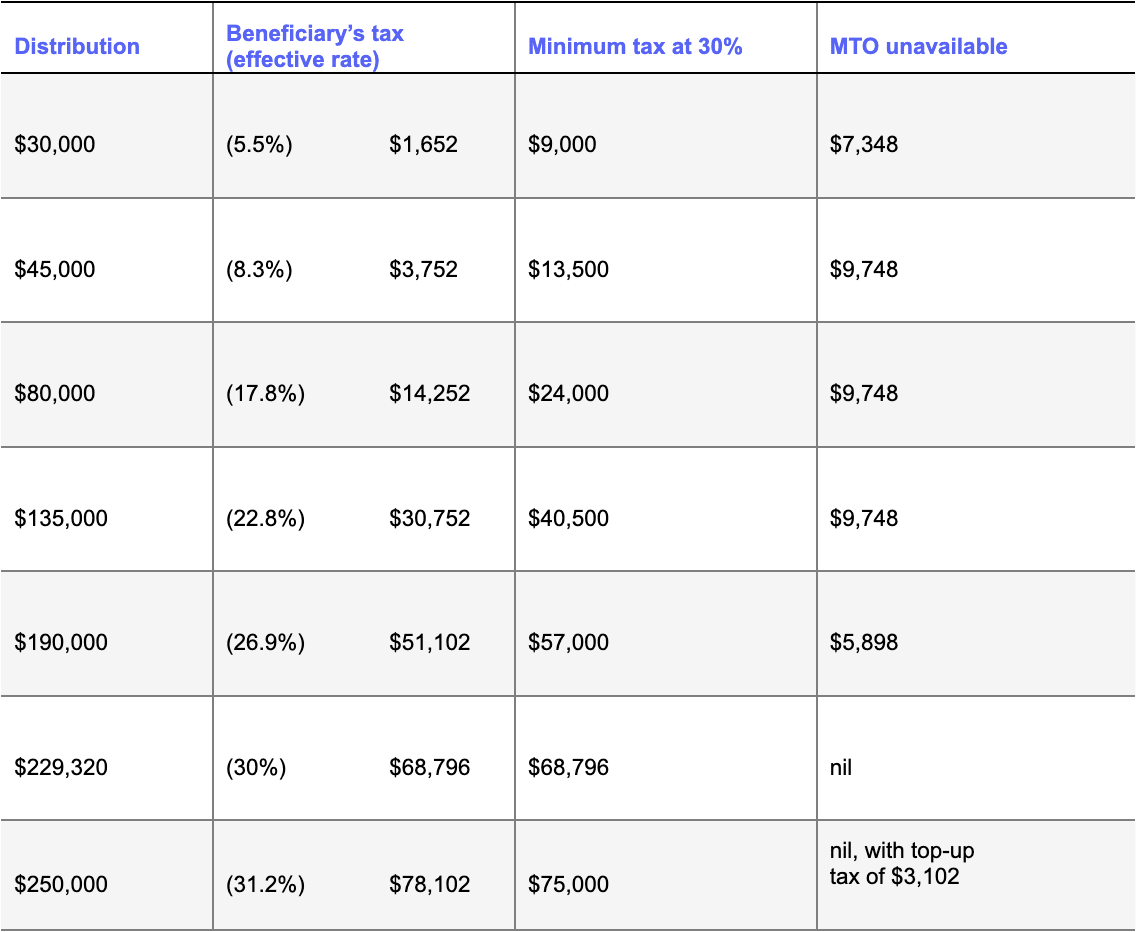
Assumes the distribution is the beneficiary’s only income; based on 2027–28 resident rates, excluding the Medicare levy and the low income tax offset.
Nor is the problem confined to modest incomes. Take a couple running a retail business through a discretionary trust that makes a net profit of $400,000 in 2027–28, distributed equally. Under the current law, they would bear tax of $111,204 between them ($55,602 each) before the Medicare levy. Under the minimum tax, the trustee pays $120,000, and each beneficiary receives a $60,000 MTO – $4,398 more than either can use – with the excess foregone. The couple pay $8,796 more tax than if they had derived the same income personally, an effective rate of 30 per cent against 27.8 per cent.
The measure is neutral only for beneficiaries with enough income to absorb the MTO in full. It bears least heavily on precisely the taxpayers whose arrangements are said to justify it.
Double taxation for corporate beneficiaries
Income distributed to a corporate beneficiary bears the trustee’s minimum tax and is taxed again in the company’s hands, with no MTO available.
To illustrate, trust income of $100 bears $69.71 of tax (as worked out below):
-
The trustee is liable for a minimum tax of $30 and pays $70 to the corporate beneficiary.
-
The company receives $70 but is assessed on the full $100 with no credit for the $30 already paid. After company tax of $30, it retains $40.
-
The company franks a $40 distribution with a $17.14 credit. A shareholder at the top marginal rate is assessed $57.14, is liable for $26.86, and, after the franking credit, owes a further $9.71.
The $30 paid by the trustee is not recognised anywhere in the chain: the company cannot access the MTO and can frank only to the extent of its own tax. Income that would bear a maximum of 47 per cent if derived personally, or received directly from the trust, is taxed at an effective 69.71 per cent through a corporate beneficiary. That cannot be reconciled with an objective of aligning the tax treatment of trust income with the rates paid by wage earners.
It also reintroduces double taxation 39 years after the imputation system was introduced specifically to remove it, and converts what should be refundable franking credits into a non-refundable offset. The result sits well outside the 47 per cent benchmark the tax law applies wherever the government has sought to strip the advantage from deferring or diverting income away from the top marginal rate. Some examples of this approach include section 99A, the fringe benefits tax, the trustee beneficiary non-disclosure tax, the family trust distribution tax (FTDT), and no-TFN and no-ABN withholding.
The practical conclusion is stark: under the current design, corporate beneficiaries become commercially unviable as of 1 July 2028.
Chains of trusts
Where a trustee beneficiary is itself a discretionary trust, the MTO is applied against that trust’s own liability. Any excess is non-refundable, and cannot be carried forward or passed on to further beneficiaries. The MTO reduces the amount of tax a trustee must pay; it does not reduce the trust’s minimum tax liability. A trustee beneficiary that discharges its liability using an MTO received from an earlier trust in the chain has paid nothing but remains liable for 30 per cent of its taxable income and passes on an MTO of that amount. The chain is therefore neutral so long as each trust’s liability matches the MTO it receives.
However, it is not neutral when certain deductions or losses reduce the taxable income of a trustee beneficiary, thereby reducing the MTO that can be passed on to further beneficiaries. Those deductions reflect a genuine cost of deriving the income, and beneficiaries should not bear a 30 per cent floor on income the group never had.
Loss recoupment is affected too
Two loss outcomes deserve attention, because both are particularly unfair.
Profit trust to loss trust
Where a profit trust distributes to a loss trust in the same family group, the income injection test in Schedule 2F to the Income Tax Assessment Act 1936 (Cth) does not currently prevent the loss trust from offsetting its loss against the income distributed from the profit trust, because the benefit comes from someone who is not an outsider. This has been settled policy for 31 years.
Under the minimum tax, the income bears the 30 per cent floor before it reaches the loss trust. The losses can no longer be offset against it; the MTO is worthless to a loss trust and cannot be passed on, and the losses are effectively unavailable. The groups hit hardest are those that made (generally) irrevocable family trust elections precisely to satisfy the income injection test, leaving legacy elections and unusable losses.
Individuals with losses
The same problem reaches individuals, and it arises with a single trust, not just chains. Today, a beneficiary with current-year or carried-forward tax or capital losses can apply them against a distribution or a distributed capital gain received from a discretionary trust.
Under the minimum tax, the 30 per cent floor applies before the distribution reaches them, and the MTO is useless to a beneficiary with no tax liability. Yet a trust distributing wholly to individuals is precisely the structure the policy appears designed to encourage. It is inherently unfair that an individual with tax or capital losses cannot recoup them before the minimum tax is applied at the trustee level.
Vulnerable beneficiaries lose the tax-free threshold
The exclusions for vulnerable minors and special disability trusts (SDT) are welcome, but a person does not cease to be vulnerable on attaining 18 years of age. For an adult with a permanent disability outside the SDT framework, or any beneficiary whose income is below the tax-free threshold, the minimum tax converts an effective rate of nil into 30 per cent. A non-refundable offset is worthless to someone with no tax liability.
Consider a common and entirely legitimate arrangement: a distribution to a spouse who contributes to the household in non-financial ways and is on parental leave or unwell and unable to work. Today, they are taxed at their marginal rate with the benefit of the tax-free threshold. Under the minimum tax, the same distribution is subject to a 30 per cent floor.
The approach appears in stark contrast to the minimum tax on capital gains, which exempts income support recipients precisely to avoid disadvantaging low-income earners. The same logic applies here.
Child maintenance trusts are another gap: their income is already excepted trust income, yet they are not excluded, whereas SDTs are.
Charitable beneficiaries receive 70 cents in the dollar
Excluding charitable trusts from the measure does not address the extent to which the sector is funded by distributions from discretionary trusts. Where the recipient is a deductible gift recipient (DGR), the trust deducts the gift, and the DGR receives its full value.
However, where it is not a DGR and the trust distributes to it as an income-tax-exempt beneficiary, the trustee pays the minimum tax and generates an MTO that the organisation cannot use. In these circumstances, the tax-exempt entity receives only 70 per cent of the gift. Some of the hardest hit organisations from these measures will include churches and other religious organisations, schools, and not-for-profit sporting and community associations; they will simply have less money to work with.
Who really bears the tax? That is a trust law question
The minimum tax is imposed on the trustee, but tax law does not – and cannot – determine whether the liability is funded from trust income or trust capital. That turns on trust law and the terms of each deed. Imposing the tax on the trustee does not alter beneficiaries’ equitable entitlements, and a beneficiary can still call for payment of their full entitlement.
Fund the liability with capital, and the cost may fall on beneficiaries who received nothing or on a later generation. Fund it from income, and it falls on the income beneficiaries as a class, in a year after the entitlement arose, rather than on the beneficiary whose distribution attracted it. Trustees are left balancing fiduciary duties against tax obligations, with their decisions open to challenge by whichever class bears the cost.
Trustees will need to determine the source of funds for the minimum tax, their authority to retain amounts for that purpose, and how to allocate the liability between income and capital, and among beneficiaries, where the deed is silent.
‘Reverse streaming’
Certain classes of income will be exempt from the minimum tax, including primary production income, certain income relating to vulnerable minors, amounts subject to non-resident withholding tax, and income from deceased estate assets of testamentary trusts.
In a significant new compliance obligation imposed on trustees, they will need to identify and separate those classes to apply the minimum tax correctly – a form of ‘reverse streaming’, with no precedent beyond the current streaming rules that apply to franked distributions and capital gains.
The rollover is not the ‘escape hatch’ it is made out to be
A three-year rollover is proposed from 1 July 2027 to 30 June 2030, switching off CGT and FTDT for qualifying restructures, extending to trusts of any size and to all assets, and dispensing with the ‘genuine restructure’ condition. All welcome. But five practical problems stand in the way.
State duty
State and territory transfer duty will be the single biggest barrier. The Commonwealth can switch off CGT and income tax but not duty. Western Australia and Queensland, the most onerous jurisdictions, impose duty on business assets as well as on real property, and, outside South Australia, the transfer of business real property attracts stamp duty.
An identical restructure may be exempt in one jurisdiction and cost millions in another, so the benefit of the rollover turns on where the business is located. Meanwhile, each level of government treats the stalemate as the other’s problem and bridging that gap before 1 July 2027 would require extraordinary intergovernmental negotiations.
Every restructure is equivalent to a sale of business
On an ‘all assets’ design, each rollover carries the commercial and legal freight the tax law does not touch: property titles and vehicle re-registrations, banking, employment contracts and accrued leave, awards and enterprise agreements, leases, licences and permits, landlord and lender consents, insurance, intellectual property, related party loans, supplier and customer agreements, and regulatory notifications.
The rollover window
The rollover should be permanent. A trust that qualifies in 2029–30 should equally qualify in 2033–34, particularly where the relief is underpinned by integrity conditions. At the very least, it should remain available where a restructure cannot be completed in time because third-party consent has not been obtained.
Key concepts are undefined
The ‘statutory family unit’ is central to determining whether a restructure qualifies, yet its meaning remains to be explained. How will ownership be traced where there are no fixed interests? It should be at least as wide as the existing family group in Schedule 2F.
Restricting relief to companies with a single class of shares would deny relief to family companies that separate voting from economic rights for a range of non-tax reasons, including ordinary succession and employee participation in the entity. The test should be whether income and capital can be redirected on a discretionary basis. A company owned by a discretionary trust will also not be eligible as a transferee.
Other considerations
Clarity is also needed on the following related issues:
-
Losses, which cannot be transferred to the transferee entity, so a trust that moves all its assets abandons them.
-
The treatment of existing Division 7A arrangements on a rollover, and of arrangements not currently subject to Division 7A but which would be if made by a private company.
-
The deductibility of advice and rollover execution costs, which would seem to be tax-related expenses and deductible under section 25-5 of the Income Tax Assessment Act 1997 (Cth).
Also, restrictions may apply where trust assets are the subject of matrimonial proceedings or an ATO review or audit. A party to those proceedings may seek an injunction restraining disposal.
Three unsettled regimes
Clients weighing whether and how to restructure must do so against three sets of rules in simultaneous motion: the minimum tax, the rollover, and the treatment of unpaid present entitlements (UPEs) following the High Court’s decision in Commissioner of Taxation v Bendel [2026] HCA 18 and the revised announced but unenacted measure from the federal budget 2018–19 to bring UPEs within Division 7A.
The cumulative effect deserves attention: income distributed to a corporate beneficiary may bear the minimum tax at the trustee level, be taxed at the corporate rate, and, if the revised measure applies, be subject to deemed dividend treatment of the UPE. Three impositions on the same income would be disproportionate to any integrity concern.
Certainty is needed well before the rollover opens on 1 July 2027, not merely before commencement on 1 July 2028. Estate planning cannot wait either: wills and testamentary trust provisions are drafted daily in reliance on the current law, and a client advised today may die or lose capacity before the design is settled.
What to do now
NTAA is of the view that the measure should not proceed in its current form, and has asked Treasury to release exposure draft legislation and explanatory materials for public consultation before any enabling legislation is introduced into parliament. The passage of the first tranche of legislation containing the negative gearing and CGT changes without an exposure draft is not reassuring.
In the meantime, practitioners should:
-
Identify every client group that contains a discretionary trust, and map the beneficiaries and their likely income levels to determine who is exposed.
-
Flag corporate beneficiaries and existing UPE arrangements, as these clients face the worst outcomes and the most unsettled law.
-
Scope duty exposure early for any group likely to restructure, mindful that the rollover will not be a cost-free exercise.
-
Identify trusts and individuals with carried-forward tax or capital losses, and quantify the amount at risk.
-
Read the deeds to understand how the minimum tax will interact with amounts beneficiaries are entitled to and can call for under trust law.
Importantly, practitioners should not undertake any restructuring yet. Too much of the design is unresolved, and a premature restructure may be measured against rules that look materially different by the time they are legislated.
However, practitioners should reach out to clients who will be adversely affected by these measures to inform them of the conversations ahead and the follow-up discussions that will occur once the details of these measures are released.
NTAA’s submission on the consultation paper can be found here.
About the author
Robyn Jacobson is the senior advocate at the National Tax & Accountants’ Association Ltd (NTAA). She is a fellow of NTAA, CA ANZ, and CPA Australia, and a chartered tax adviser with The Tax Institute.
About NTAA
NTAA is a prominent not-for-profit association, established in 1992 to support tax agents, accountants and tax advisers. For more than 30 years, NTAA has advocated on behalf of its members and supported them through its highly regarded tax seminars, products and hotline service. NTAA is a major representative voice for the tax community, representing more than 45,000 practitioners.
Read more at ntaa.com.au
 Want to see more stories from trusted news sources?
Make Accountants Daily a preferred news source on Google.