


 iscover
 Lease Doc vs Full Doc: Which Commercial Loan Fits?
BusinessA side-by-side comparison for accountants: how Lease Doc and full-doc commercial loans differ on paperwork, timing and serviceability.
When a client is buying a tenanted commercial investment property, there's usually more than one way to finance it. The two most common paths — full-doc and Lease Doc — start from different questions. Full-doc lending asks “can the borrower service this loan?” Lease Doc lending asks “can the lease service this loan?” That single difference in starting point flows through to paperwork, timing and which clients each option actually suits.
What full-doc commercial lending looks at
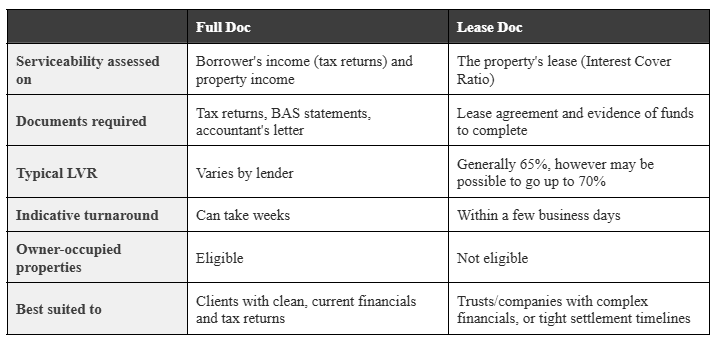
A full-doc application builds its serviceability case from the borrower. That typically means tax returns, BAS statements, and often an accountant's letter confirming income and structure. For clients with straightforward, up-to-date financials, this is a well-worn path and can unlock a broader panel of mainstream lenders. But it can slow down — or stall — when a client's latest tax return doesn't reflect their current trading position, when a trust or corporate structure has complex consolidated accounts, or when the accountant's letter itself becomes a bottleneck in the settlement timeline.
What Lease Doc lending looks at
Lease Doc lending sets the borrower's tax history aside and assesses the property's lease instead. The lender calculates an Interest Cover Ratio from the tenant's rent to confirm it comfortably services the proposed loan. No tax returns. No BAS. No accountant's letter required to get started. For eligible purchases, Lease Doc loans are available up to 70% LVR, and a specialist broker can typically come back with an indicative loan amount and rate within one business day.
Where each option tends to win
Full-doc suits clients whose financials are current, straightforward and ready to present — it's often the cheaper, more flexible path when there's no reason not to use it. Lease Doc tends to win when:
The client's latest tax return understates their current position, the ownership structure is a trust or company with financials that take time to consolidate, or the deal is on a tight settlement timeline that a full serviceability assessment would jeopardise. In each of these cases, Lease Doc isn't a workaround for a weak deal — it's a different, faster route to the same destination for a deal that's already strong on its own terms, provided the lease itself stacks up.
At a glance
What Lease Doc doesn't do
It's worth being clear about the limits. Lease Doc lending is not for owner-occupied properties, and it isn't a way around genuine serviceability — the lease still has to support the loan. Vacant properties, short lease terms, or tenants on shaky footing will be scrutinised carefully by lenders regardless of which path is used, and every application remains subject to full credit assessment, valuation and individual circumstances.
Making the call
For accountants, the practical question isn't “which product is better” in the abstract — it's which one gets a specific client's deal across the line on the best terms, given their financials and timeline. A client with clean, current financials and no time pressure may be best served by a standard full-doc application. A client with a strong lease but paperwork that isn't quite lender-ready — or a settlement date that won't wait — is often better served by Lease Doc.
LeaseDoc.com.au is operated by Commercial Warehouse Pty Ltd (Australian Credit Licence 493348) and works with a panel of lenders that specialise in lease-assessed commercial lending, with an indicative rate currently from 6.49% for loans over $1m. Because Lease Doc sits outside standard full-doc policy, pricing and appetite vary meaningfully between lenders — which is where a broker who works across both spaces adds value, matching the right structure to the right lender for the deal in front of them.
Clients can send through a lease directly at leasedoc.com.au for an indicative comparison, or accountants can make a warm introduction on their behalf by calling 1300 569 362.
This article is general information only and does not constitute financial or credit advice. The rate quoted is indicative only, correct at the time of publication, and subject to change without notice. Actual rates and loan terms vary based on the security property, lease, LVR and individual circumstances. All loan applications are subject to full lender credit assessment, valuation and individual circumstances. Commercial Warehouse Pty Ltd, Australian Credit Licence 493348.
 Want to see more stories from trusted news sources?
Make Accountants Daily a preferred news source on Google.