


 iscover
 Imagining an Alternative Workforce Structure for the Accounting Talent Shortage
BusinessIn 2025, Jobs and Skills Australia added tax accountants and external auditors to the country’s Occupation Shortage List—a move consistent with Chartered Accountants Australia and New Zealand’s earlier findings of accountant shortages across states and territories.

The pipeline of critical accounting talent continues to decline even as demand for the same is projected to rise to approximately 28,000 by 2029. That’s three years from this time of writing.
To meet that number, government and industry bodies must pursue targeted investments in education and policies to both support skill development and lower barriers to entry. But even those could take years to yield the qualified professionals businesses needed yesterday. There lies the challenge: How should firms structure their workforce in the meantime to sustain operations
Rethinking Workforce Architecture
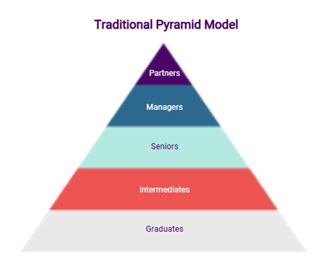
The traditional pyramid model pictured above assumes graduates want to climb their way up to partner. While that may be true for many, the scheme only works when the talent supply is healthy.
At the moment, junior accountants often end up spending years performing data entry and reconciliation before touching advisory responsibilities. Mid-level staff get trapped in process management instead of developing strategic capabilities. And then we have partners, who carry heavy workloads because there aren’t enough seniors ready to take on client relationships.
In our view, the shortage of accountants in Australia is as much about championing the development of existing talent as it is about finding new hires. Firms must then address another question: How could they restructure the way work is distributed to pave faster pathways to senior capacity?
The Modern Diamond Model
At TOA Global, our more-than-a-decade-long work with accounting practices has allowed us to develop an approach that distributes work across three tiers based on expertise rather than tenure alone:
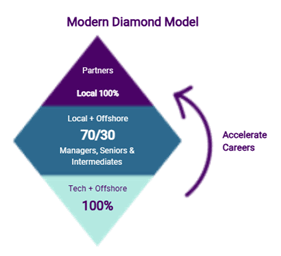
Partners: 100% Local
At the top of the diamond, partners remain focused on client relationships and practice leadership. They stay 100% local since their roles require deep market knowledge and the judgment that comes from years of industry experience.
Managers, Seniors, and Intermediates: 70/30 Local-Offshore Mix
The middle tier is a split: the 70% local portion focuses on technical reviews, client-facing advisory, and team leadership. The 30% offshore, on the other hand, handles compliance work and quality assurance tasks that require accounting expertise but may not necessarily demand local presence.
Tech + Offshore: Foundational Tier
The combination of tech automation with offshore capacity at the bottom of the diamond can serve high-volume, process-driven work well. That includes bookkeeping, data entry, document management, and initial reconciliations.
This layer provides capacity that doesn’t compete for scarce local talent and doesn't create bottlenecks during busy seasons.
How the Model Accelerates Careers
The diamond talent model aims to remove common bottlenecks in career progression. When graduate accountants aren’t spending their entire time on data entry, they can begin engaging with client-facing work earlier in their tenure.
Similarly, mid-level accountants who manage offshore colleagues and coordinate workflows across distributed teams can develop the leadership skills and eye for judgment they’ll need as senior leaders.
And for highly experienced accountants, the model is about protecting capacity. With compliance tasks managed at the foundational tier, senior talent can focus on higher-value advisory and client relationship building—work that tends to keep them engaged in the profession longer.
The Two-Office Strategy
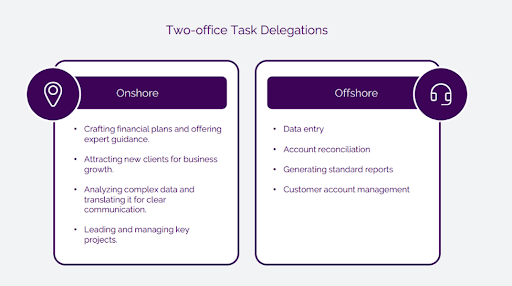
Ultimately, the career progression promised by the diamond model hinges on how well global team members are integrated into your practice. We call this the two-office strategy.
In practice, it means shared tech platforms, real-time collaboration tools, same quality standards, and regular communication cadence across time zones. The goal is for offshore accounting teams to function as an extension of your in-house capability. They’re the same team but in a different location.
Bridging the Present to Long-Term Solutions
The accounting talent shortage requires action at multiple levels across education, immigration reform, and retention programs. These changes are non-negotiable if we are to rebuild the pipeline over the long term.
However, practices don’t have the bandwidth to wait for these solutions to mature. They need to continue serving clients and pursuing growth while simultaneously advocating for the career development of existing teams. That is to say, turning graduates into senior advisors and keeping experienced practitioners in the profession longer by protecting them from burnout.
What we’ve found is that the diamond model can support this need. Fundamentally, it’s about matching the right work to the right capability level, which should render it effective even as talent supply conditions eventually improve.
 Want to see more stories from trusted news sources?
Make Accountants Daily a preferred news source on Google.