


 iscover
 The 15-minute audit: why AI makes hourly billing operationally impossible
BusinessAs AI agents handle growing portions of junior workloads, firms must pivot to value-based pricing or face a terminal margin squeeze, writes Andrew Cooke.

"Price is what you pay. Value is what you get." Warren Buffett said that decades ago. AI has finally made it operationally true.
A partner at a Sydney mid-tier firm recently described a moment that stopped her cold. Her most junior staff member had completed a bank reconciliation that would have taken two hours 18 months ago. The AI-assisted process took 11 minutes. The work was flawless.
She billed the client for 11 minutes.
At $250 per hour, that reconciliation became worth $45.83. The professional expertise, the risk management, the decades of accumulated knowledge embedded in that AI system – all of it collapsed into less than $50. This is not a billing anomaly. It is the new operating reality.
The efficiency trap nobody prepared for
A 2024 CPA Australia study found that firms implementing AI-assisted workflows reported efficiency gains of 40 to 60 per cent on routine compliance work. But firms billing by the hour saw revenue per engagement drop by nearly the same percentage.
Getting faster made them poorer.
The profession has created a billing model that actively punishes competence. The better a firm gets, the less it can charge. This was always theoretically true, but improvement was slow enough to absorb. AI has compressed decades of efficiency gains into months. The absorption capacity is gone.
Myth: "We'll reinvest efficiency gains into advisory work. The timesheet model survives if we shift what we're billing for."
Reality: Capacity freed by AI on compliance cannot automatically convert into advisory. Advisory requires different skills, different relationships, and different pricing conversations. A Melbourne mid-tier firm discovered its partners, trained in compliance delivery, struggled to sell advisory engagements. Efficiency gains sat unused while fixed costs remained. Within eighteen months, margins compressed by 22 per cent.
This is why AI is 20 per cent technology and 80 per cent psychology. The technical capability to deliver faster is trivial compared to the cultural shift required to price differently.
The efficiency-value matrix: three quadrants that matter
The firms navigating this transition successfully have stopped asking "how long did it take?" and started mapping every engagement to a simple framework with three actionable quadrants.
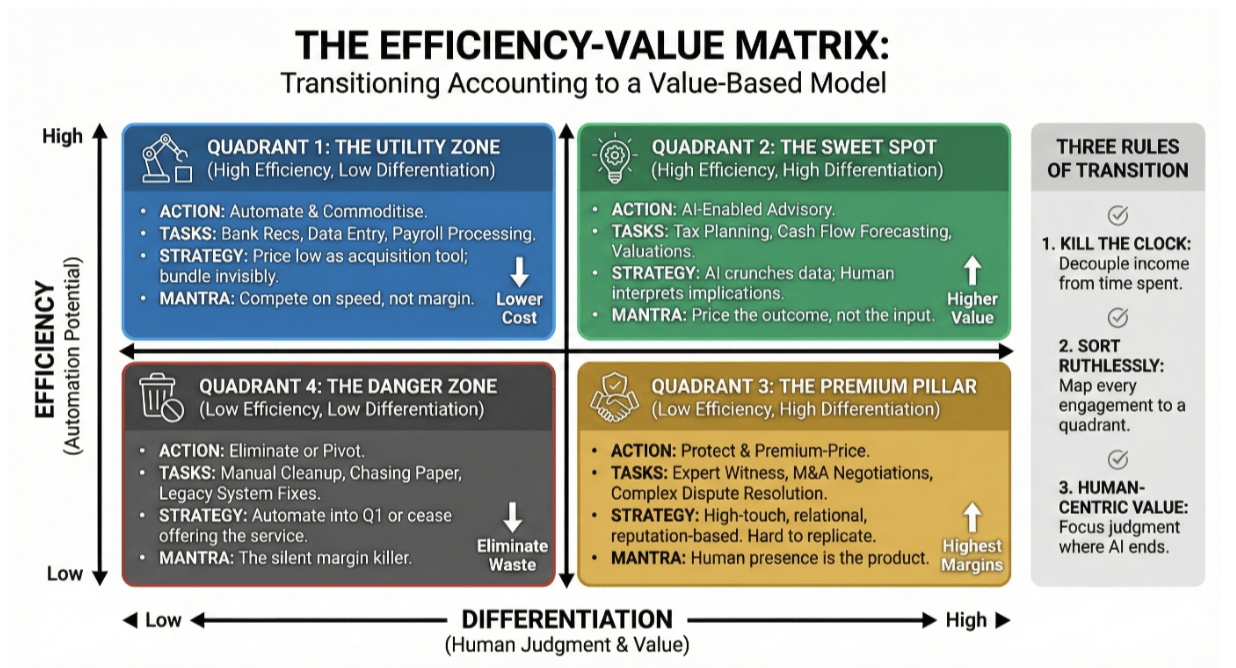
Quadrant 1: High efficiency, low differentiation. Bank reconciliations, data entry, and initial document processing. Price this work aggressively low as a client acquisition tool, or bundle it into higher-value offerings. Trying to extract premium fees from commoditised work is a losing battle.
Quadrant 2: High efficiency, high differentiation – the sweet spot. AI-enabled advisory. Tax planning in which AI runs scenarios while the accountant interprets the strategic implications. Business valuations where AI processes data, but professional judgement determines the opinion. The work is faster, but value is defined by human decision-making. Price on outcomes, not inputs.
Quadrant 3: Low efficiency, high differentiation. Expert witness testimony. Complex dispute resolution. Board advisory. These engagements resist automation because their value is fundamentally relational. AI may assist with research, but the deliverable is human presence and real-time judgement. Premium price accordingly.
Three moves toward value-based pricing
- Start with scoping, not engagement letters. Invest time understanding what outcome the client needs – and what that outcome is worth to their business. A tax return that saves $50,000 in legitimate deductions is not the same as one that confirms the client is already optimised.
- Decouple internal tracking from external pricing. Firms still need to understand where time goes – for resource planning and coaching. But the moment time records appear on a client invoice, the firm has surrendered its pricing power. Track time internally. Price externally based on value.
- Measure margin per engagement, not recovery rate. The traditional metric – what percentage of recorded time was billed – is meaningless in an AI-enabled firm. An engagement completed in two hours, generating $3,000 at a 60 per cent margin, is preferable to a ten-hour engagement generating $2,500 at a 15 per cent margin.
If a firm is still asking "what's our recovery rate?" rather than "what's our margin per client?", the transition has not begun – regardless of how many AI tools have been deployed.
The asset that depreciates daily
Time is now a depreciating asset for any firm that sells it. Each month, AI improves. Each quarter, tasks that took hours take minutes. Firms clinging to hourly billing are building their economic model on a foundation that erodes with every technological advance.
Sell time, and every improvement makes the firm worth less. Sell outcomes, and every improvement becomes a competitive advantage. The difference is not the technology firms choose – it is the human judgement they protect.
Andrew Cooke is the managing director of Growth & Profit Solutions.
 Want to see more stories from trusted news sources?
Make Accountants Daily a preferred news source on Google.